Wake Up Dead Man: How it Excuses Religion’s Harm
Note: This article contains massive spoilers for Wake Up Dead Man.
When it was announced that the third film in the Knives Out series, Wake Up Dead Man, was going to be set in a Church I was thrilled. Spending as much time as I do deconstructing an Evangelical kids propaganda radio drama, I hoped that this film would provide the same skewering of religion that the first film so gleefully brought to entitled rich people.
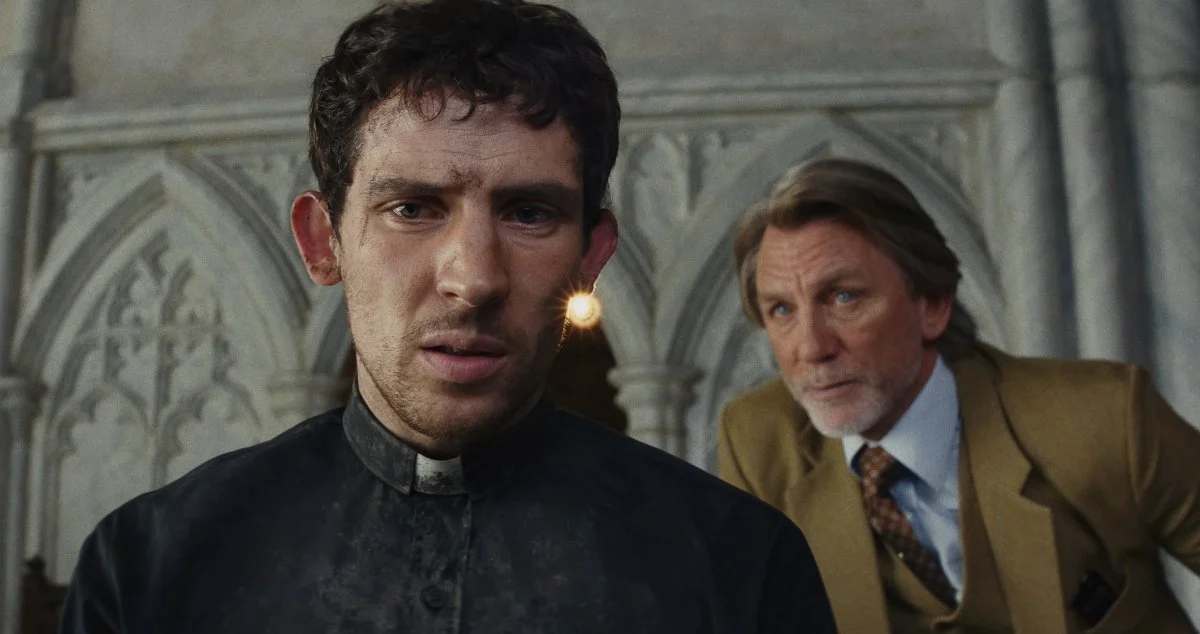
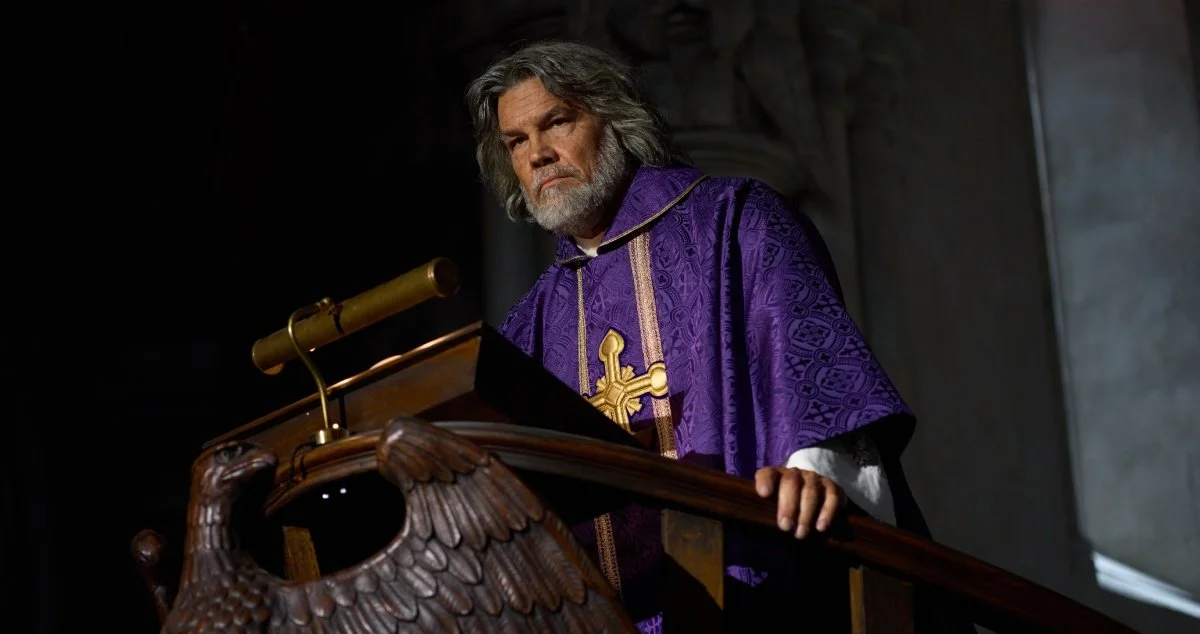
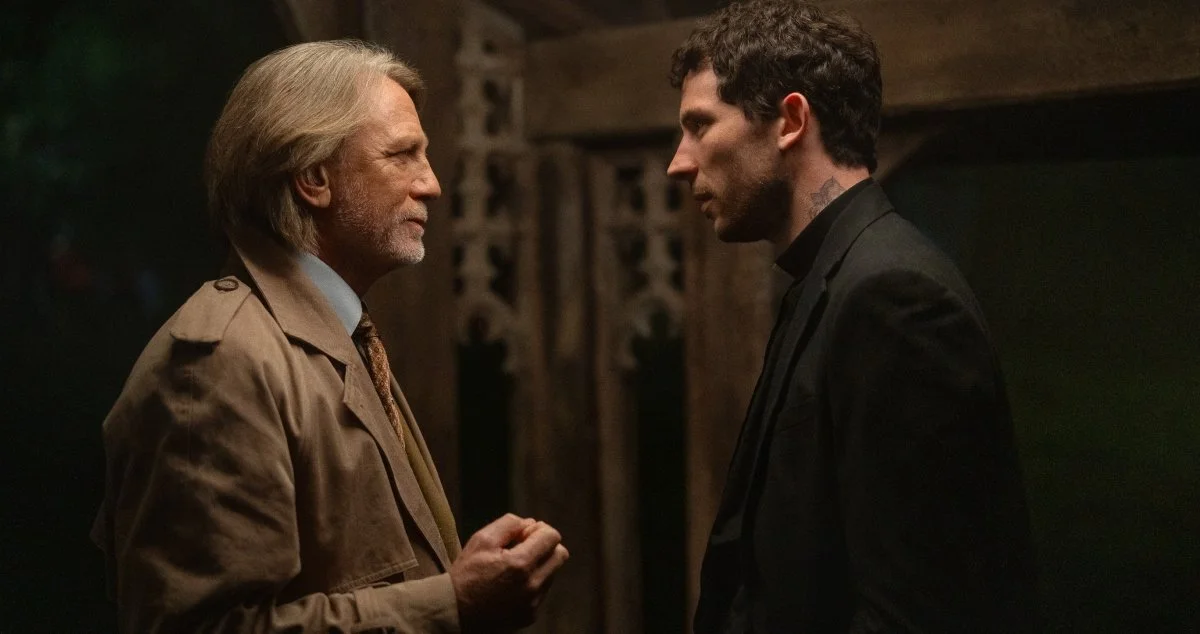
The story follows detective Benoit Blanc investigating the murder of Wicks, an asshole monsignor (more or less a priest), alongside well-meaning suspect (and fellow priest) Jud. After my first viewing I was broadly satisfied by it. The film managed to come off fair and balanced when it came to religion. This wasn’t a teen atheist “dunking” on faith nor blatant Christian propaganda but instead one that strove to display the platonic ideal of what Christians could be, as embodied by Jud. Kind and helpful despite his dark past, ultimately willing to do the right thing, even take the fall for a murder he knows he didn’t commit. He doesn’t force Blanc or anyone else to believe in God. He simply shows grace to, “those who deserve it the least.” Blanc, in return, only shares a few harsh words about religion throughout the film but ultimately respects Jud’s faith.
Jud is what we, as non-believers, want Christians to be like. Blanc, to believers, doesn’t let his “petty” differences with Jud over faith get in the way of helping others. Yes, there are bad people, like Wicks, in religion who use its power to hurt others but there’s still good to be found there. Grace and kindness that just happens to come from God.
Wake Up Dead Man, even to a bitter non-believer like myself, did an admirable job when it came to showing “both sides” of religion.
Right?
The more I sat with the film the more I questioned my first impressions. The previous Knives Out films were relentless in their skewing of their chosen subjects yet this one pulled its punches when it came to religion. Director and writer Rian Johnson stated in an interview with Sojourners that the film was, “created with a thoughtful and generous spirit. I did a lot of work when I was making it to make it a multifaceted conversation as opposed to a didactic, finger-waggy thing on one side or the other.”
In theory that’s a good way to approach the film. Both sides in an argument deserve to be heard and being didactic rarely wins anyone over. But the main problem is the film is so careful to show religion in a positive light that any of its meager criticisms are too easily lost or excused away. This is demonstrated in the glowing review of the film by Plugged In, a Christian movie review website run by none other than noted hate group Focus on the Family. You know, the ones who produce that Evangelical kids propaganda radio drama, Adventures in Odyssey, I mentioned.
“For those who enjoy a good mystery with a dynamite cast, Wake Up Dead Man is a first-rate whodunit, growing more satisfying with each outlandish twist. It wrestles with questions of faith honestly. It examines the Church critically, but with compassion. The movie’s faith-based musings offer their own rewards—and challenges.” - Plugged In
It’s not all positive. We do get Plugged In trademarks such as the prudish refusal to fully spell out curse words, a “sexual & romantic content” section filled with oddly detailed descriptions of said content, and the need to point out that, in a murder mystery film, people lie. Yet on the whole the review heaps on the praise.
So. The organization that creates religious propaganda for children with messages like, “deep down we are all evil” and “it’s God’s will that your parents beat you”, likes the film. Huh. That’s a problem.
You may scoff at this positive review from Plugged In. “Wow, they sure must be deluded. How could a known Christian hate group enjoy this movie? I mean, Wicks talks about masturbating multiple times.” But that assumes that “bad” Christians will identify with the bad Christian in the movie. They don’t. They see themselves in Jud. In the review’s “Spiritual Elements” section they state,
“The film pits Wicks and Jud against each other—with Wicks insisting that Christians need to fight to reclaim the ground they’ve lost, and Jud arguing that the only way forward is through radical, Christlike love. “Christ came to heal the world, not fight it,” he says.”
It later goes on to say, “let’s not ignore the fact that some conservative Christians might feel like Johnson’s finger is pointed at them—never mind that those same conservative Christians would actually embrace much of what Father Jud says, too.”
Even though Focus on the Family are fully aware that this film is made by someone who “walked away from faith,” they still see his supposed “multifaceted conversation” as an endorsement of their faith. They look at Jud’s faith, how he claims God brought him grace, and see it as Johnson secretly hoping all things Christian are true.
“When Benoit Blanc first walks into Our Lady of Perpetual Fortitude, he makes no secret to Father Jud about his lack of faith. He looks at the sanctuary and feels it’s a religious Disneyland—from the splashy neogothic architecture on down. “The rites, rituals, the costumes, all of it,” he says. They smack of fairy tales. They’re just stories…
Just stories? The Blanc side of Johnson would say so. But the movie suggests they can be beautiful stories, sometimes life-changing stories. And in Father Jud, we get an inkling that even now, Johnson hopes that they just might be true.” - Plugged In
There’s a kneejerk reaction to treat this as silly. “Wow, these wacky Christians really didn’t get this movie, huh!” But when you rewatch the film you notice how, in its attempt to have a “multifaceted conversation,” it sands off the worst parts of religion or silos them into easy to disregard fringe cases. The treatment of Wicks is the most obvious example. He’s fowl, abusive, and openly hateful to those following him. It’s simple to disregard him as “not a real Christian,” especially when his following is so small. I know for a murder mystery it makes sense to not have hundreds of people in that Church in order to limit the potential suspects but the fact he’s got less than ten regular members? It makes it that much easier to dismiss him as just a bad apple. Even Jud recognizes that the most faithful of Wick’s followers would admit, “this is not the true church... This is not what they believe. It’s Wicks being Wicks, pushing it too far.”
That’s more than enough for many Christians and religious people watching to wash their hands of Wicks. To see him solely as one bad dude, not a reflection of themselves or any systemic problems in religion, and move on.
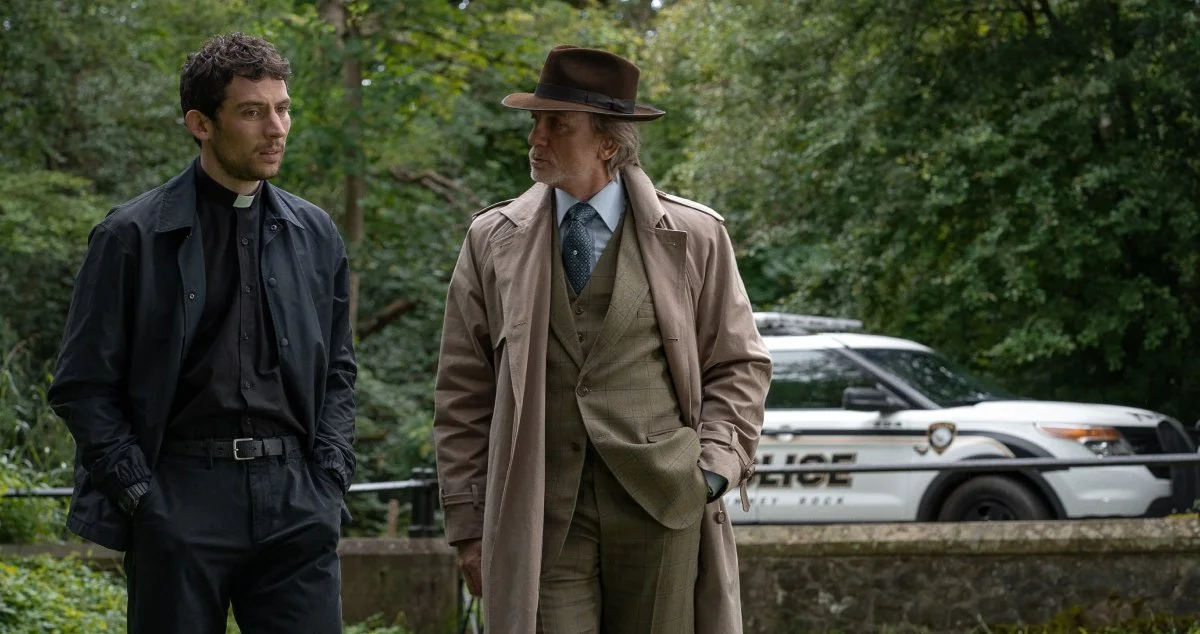
The more concerning “sanding off” of the negative parts of religion, paradoxically, come from how it portrays the “right ways” to be Christian. Particularly in how it handles the subject of grace. Throughout Blanc observes the grace Jud has for those around him, grace that’s fully attributed to him being a Christian. This moves Blanc so much that he ends up withholding crucial information needed to wrap up a case. Jud showed Blanc that he should have, “grace for my enemy. Grace for the broken. Grace for those who deserve it the least. But need it the most. For the guilty.”
This sounds nice. Yeah, murderer Martha had a tough life and it’s nice someone finally listens to her story for once. But, you know she did murder multiple people. As Brooklyn Nine-Nine so perfectly put it, “cool motive, still murder.” More important however is the very grace Blanc and Jud extend to Martha for doing some murders is the same sort of “grace” that those in power in real-life churches use to excuse their horrific actions.
A preacher under investigation might say, “I know I sexually assaulted that girl, but I’m just a broken man, show me some grace.”
“Bet,” his congregation and the deacons of his church would respond and all would be forgiven. At worst that preacher would simply be transferred to another congregation. It happens all the time. We see similar actions from the “good” deacons at the start of Wake Up Dead Man. When Jud is given his new assignment, the deacons are fully aware that Wicks is a horrible man but they just kinda shrug their shoulders and go, “eh, just let him do his thing and maybe show him the way, yeah?” This is treated as a good and normal thing to happen in the church.
Even Jud’s noble actions, the way he takes it on the chin from Wicks for months and months, the abuse from the remaining congregation, and how he does it all with (mostly) a smile. Isn’t this great? He’s willing to do anything to help these people! Yes, that sounds nice, but it just reminds me of so much of Christianity is built on the idea of self sacrifice. Don’t think of yourself. Make your everything about the religion. If you have wants or desires those are EVIL! You should only think of what God wants you to do. Nothing else. Otherwise, to hell you go!
I don’t see Jud’s actions as noble, I see them as someone justifying the abuse he suffers as doing what, “we’re here to do… Daily bread.” This goes so deep that Jud gives himself shit for the tiny spark of joy he gets when he learns that Wick is dead. Why is that a bad thing? Jud suffered so much abuse from him! Ah, because God can see your “bad” thoughts and is always judging you, of course! To Jud, God is less a benevolent being and more randos in your social media replies just waiting to interpret every single action in the worst possible light. Grace for everyone but yourself, I guess.
Jud also goes out of his way to protect Sam, one of Wick’s followers, from “disillusionment.” You see, former alcoholic Sam found comfort and power in believing that Wick also fought a hard battle in getting sober. Except everyone in the church, besides Sam, knows Wicks drinks during the service. But instead of anyone telling Sam this, afraid he’ll fall off the wagon, Jud instead lies about it during the investigation, calling it, “storytelling to protect my flock.” I guess Jud doesn’t really think that highly of his flock, huh?
Then there’s the big scene where Jud speaks with construction company employee Louise on the phone. He’s trying to get information to solve the case but when he discovers she needs support and love? He spends hours on the phone being a kind ear for her. This emboldens Jud to stop working on the murder case, wanting to help others instead (because finding a murderer isn’t helpful I guess???) He tells Blanc that, “God didn’t hide me or fix me. He loves me when I’m guilty. That’s what I should be doing for these people. Not this whodunit game.” Again, this is the same sort of logic Wicks or other horrific preachers in the real world use to brush aside the horrors they inflict on others. “Hey, don’t worry about that awful shit I did. We need to focus on helping people, stop making a big deal about my actions which I really deserve grace for me.”
Jud explains his purpose in life is, “not to fight the wicked and bring them to justice, but to serve them and bring them to Christ.” I know what this is intended to mean, that by “serving” wicked people you’ll get them to change their ways for the better. But again, this is the kind of logic that can be used to justify serving fascists or excusing all kinds of other abhorrent behavior. Let’s not forget that Focus on the Family had Mike Pence speak at their campus during the first Trump administration and gleefully interviewed his family. If Focus on the Family has any reservations about Trump (doubtful), I’m sure they justify supporting him as simply serving “wicked” people. (Who am I kidding, they’re all in on Trump cause he hates DEI!)
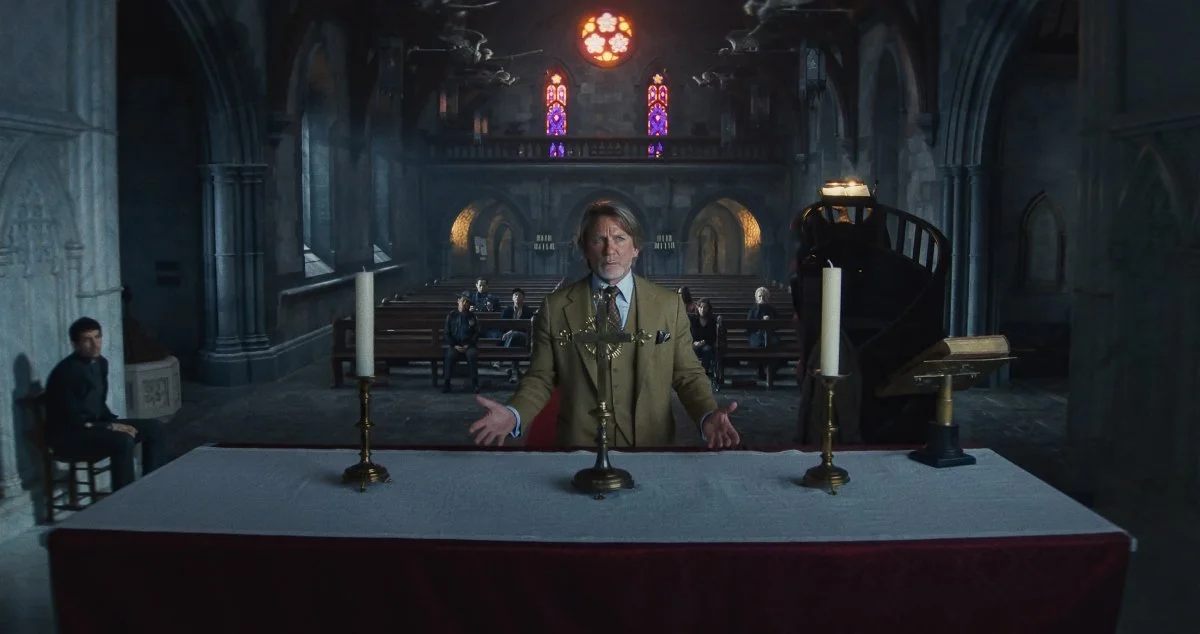
The film isn’t all about giving “good” Christians the spotlight. Blanc does get a few chances to throw in some counter arguments. When first introduced, walking in on Jud’s breakdown in the church, he calls himself a “proud heretic” who, “kneels at the altar of the rational.” We learn Blanc was raised in religion and it’s heavily implied this wasn’t a good thing. He goes off about his feeling on religion and particularly Christianity.
“It’s built upon the empty promise of a child’s fairy tale filled with malevolence and misogyny and homophobia and it’s justified untold acts of violence and cruelty while all the while, and still, hiding its own shameful acts. So like an ornery mule kicking back, I want to pick it apart and pop its perfidious bubble of belief and get to a truth I can swallow without choking.”
This is what I wanted from the film!!! Hell yeah, call out the bad things religion can do! But after this, aside from a few jabs here and there, Blanc’s views take a back seat to Jud’s. Even in that first scene, Blanc apologizes for talking shit on religion and Jud warmly responds with, “you’re being honest, that’s good.” As if Jud has the answers and is just putting up with Blanc’s lack of faith. It’s condescension masked in “grace.” Blanc, while talking about his mom, even stumbles over his words as Jud approaches him. It implies Jud, as a follower of God, is more “centered” than Blanc.
Many have praised the film for Blanc not suddenly becoming Christian or even going to mass, as we see in the final scene. He graciously tells Jud that, “there is, uh… Nothing I would rather not do.” While I do appreciate this, it’s not that different from how Evangelical drama series Adventures in Odyssey might treat this same plot. Sure, Blanc says he doesn’t want go to Church now, but the plot of film is so centered on gassing religion up that many religious viewers will smugly nod to themselves. Blanc won’t be able to resist it for long.
I don’t believe Blanc would be this generous when it comes to faith, especially after his opening salvo against the very concept. It’s also puzzling that Blanc being queer, established in Glass Onion, doesn’t play into the film. We can infer that some of Blanc’s early revulsion towards religion is based on his queer identity but it only comes up in that one scene. Why wouldn’t it come up elsewhere? This should be a huge sticking point for a man who has a “complicated” relationship with his mother because of her belief. Why doesn’t Blanc pick holes in the ideas of “grace” put forward by Jud by using the church’s open rejection of queer people as an example of how that “grace” can only go so far?
Because the film wants to be a “multifaceted conversation” and shutting Jud down with viewpoints that would be of paramount importance to Blanc would make the Christians watching it feel bad. So nah, let’s not go there and just silo it off to a single speech early in the film so Blanc can instead be inspired by Jud’s faith. Look, the gay liberal has to admit the Christian has some good points. Owned. This is the kind of wish fulfillment you see in Christian-pandering slop media, not something I’d expect from Rian Johnson’s prior work.
Returning to the Plugged In review, Focus on the Family says that, “we could see a scathing critique of a certain stripe of Christianity and a strong attaboy of another.” (Emphasis from the original review.) Yes, they could see a scathing critique but let’s be real, they won’t. They’ll find whatever they can turn into an endorsement of what they believe and move on. They won’t see Jud’s grace as something to aspire to, something they need to work on. They’ll assume they’re already at his level (if not better) and pat themselves on the back.
The core issue is that the the film blames all the bad of religion on individual people. On those who aren’t “real” Christians, who misrepresent the Church in a “dangerous way.” I’ve heard this sort of thing more than a few times while working on my massive project to deconstruct Adventures in Odyssey. That anyone who does something horrific in the same of God isn’t a “real” Christian. Well, I hear that excuse so often that maybe you need to take a look around at how and why so many people are able to use your belief system to so regularly hurt others.
Wake Up Dead Man refuses to see that the problems with Christianity, with religion, are systemic. Instead of interrogating how the sexism of religion fed into the persecution of the “harlot whore,” it’s treated as a few people’s personal failings. Instead of investigating how this system could allow Wicks to so hatefully preach for years, if not decades, it shrugs it off as just him personally going too far. Instead of Jud recognizing that he’s part of a system that heavily contributed to Martha keeping her secrets quiet for so long, he simply forgives her for doing some murders. Remember, he’s a “good” believer, so it’s fine!
For every “good” person that believes in God the “right way,” there’s so many more using that same faith to control and crush as many people as possible Even those who consider themselves “good” Christians are probably dealing with way more trauma than they’d like to admit on account of their faith.
Whenever I bring up topics like this many, even secular gays, rush to point out all the good Christians do in the world through things like donation drives, soup kitchens, etc. Which yes, that does happen, but they often come with strings attached. You gotta go to a church, you have to listen to the word, etc if you want basic, life-sustaining help. This rush to defend the charity of Christians no longer sits right with me because so many of the “good” things they supposedly offer are available from other, non religious, groups as well.
The major point celebrated about the film, that character like Jud are how Christians should act and demonstrates what religion should be about also frustrates me. It supports the idea that religion is the only way for some to turn their lives around, that without faith they’d be lawless criminals or something. Well, as we see in the film, you can have faith and still go on a murder killing spree! Why can’t we do the work without religious intervention? Why can’t we love and help ourselves, and others, without the permission of a greater being?
Why can grace, at least according to this film, only come through contact with faith? (Remember, Blanc learns to show grace because of Jud’s faith.) It’s more than possible to show grace without any faith in a religion. Everlast’s What’s It Like song shows more compassion and grace, without strings, than anyone in this film does.
Mary got pregnant from a kid named Tom who said he was in love
He said "Don't worry about a thing, baby doll, I'm the man you've been dreamin' of"
But three months later he say he won't date her or return her calls
And she swear, "Goddamn, If I find that man I'm cuttin' off his balls"
And then she heads for the clinic and she gets some static walkin' through the door
They call her a killer and they call her a sinner and they call her a whoreGod forbid you ever had to walk a mile in her shoes
'Cause then you really might know what it's like to have to choose
See, you can care about others without needing religion! You can show those that are worst off and in need of support the most grace and understanding, which I’d much rather do than excusing the actions of a bunch of well-off assholes. (Speaking of, what about all those people Wicks drove away from the Church with his hate? Where’s the grace and love for them?)
Rian Johnson, in spite of not being a believer anymore, still carries a lot of respect, admiration, and even nostalgia for Christianity. In an interview with RogerEbert.com he says that it’s, “something that I still have deep roots in and have a lot of feelings about.” In the interview with Sojourners he states that Christianity, “is a bedrock foundation for me. Once a youth group kid, always a youth group kid.” He even has “great nostalgia” for Christian rock legend Michael W. Smith.
I see a lot of myself in Rian Johnson here. Even when you leave religion, for whatever reason, you don’t want to fully disown it. You so badly want any conflicts you have with it to be excused away. You so desperately want to hold on to the “good parts.” You can see this across my own work on At My Whit’s End. Where, at the beginning of the project, I was openly complimentary to the work of Focus on the Family’s radio dramas. Reading the best I could into even the most morally repugnant entries.
At some point however you have to confront the “good” parts just as you do the bad. The fun youth group outings, the catchy tunes, or the few episodes of Adventures in Odyssey that still vaguely hold up. All of those were done to get you into the funnel of religion. To get you under the control of others who wielded the power of “God” or whatever else to keep you in line. To make you a servant by any means necessary. To strip you of who you are and to replace it with whatever they deemed to be “good.”
The “good” parts of religion are often merely tools to indoctrinate you into a system that’s rotten to the core.
Which is why the praise of Jud and how he’s what religious people “should” be like rings hollow to me. Jud, and others like him in the real world, are trying to save a crumbling system built on poison and ash. Can you do something “good” with religion? Sure, but is it worth it with all the systemic rot you have to cut through? At some point when do you say, “the thing I believe in is too easily corrupted by others” and look elsewhere?
Is there good to be had in this film? Of course, it’s a solid murder mystery. But I could say the same thing about episodes of Adventures in Odyssey (which has more than a few murder mystery episodes.) Wake Up Dead Man comes off more as light propaganda for religion than it does as an actual examination or “multifaceted conversation” of it. In this film trying to “both sides” religion, it ends up excusing the system that regularly abuses people’s very souls.
To put it bluntly, if you’re placating that kind of system instead of openly challenging and pissing it off, what’s the point?