Noah’s Flood and Adventures in Odyssey: Focus on the Family and Anti-Science Indoctrination
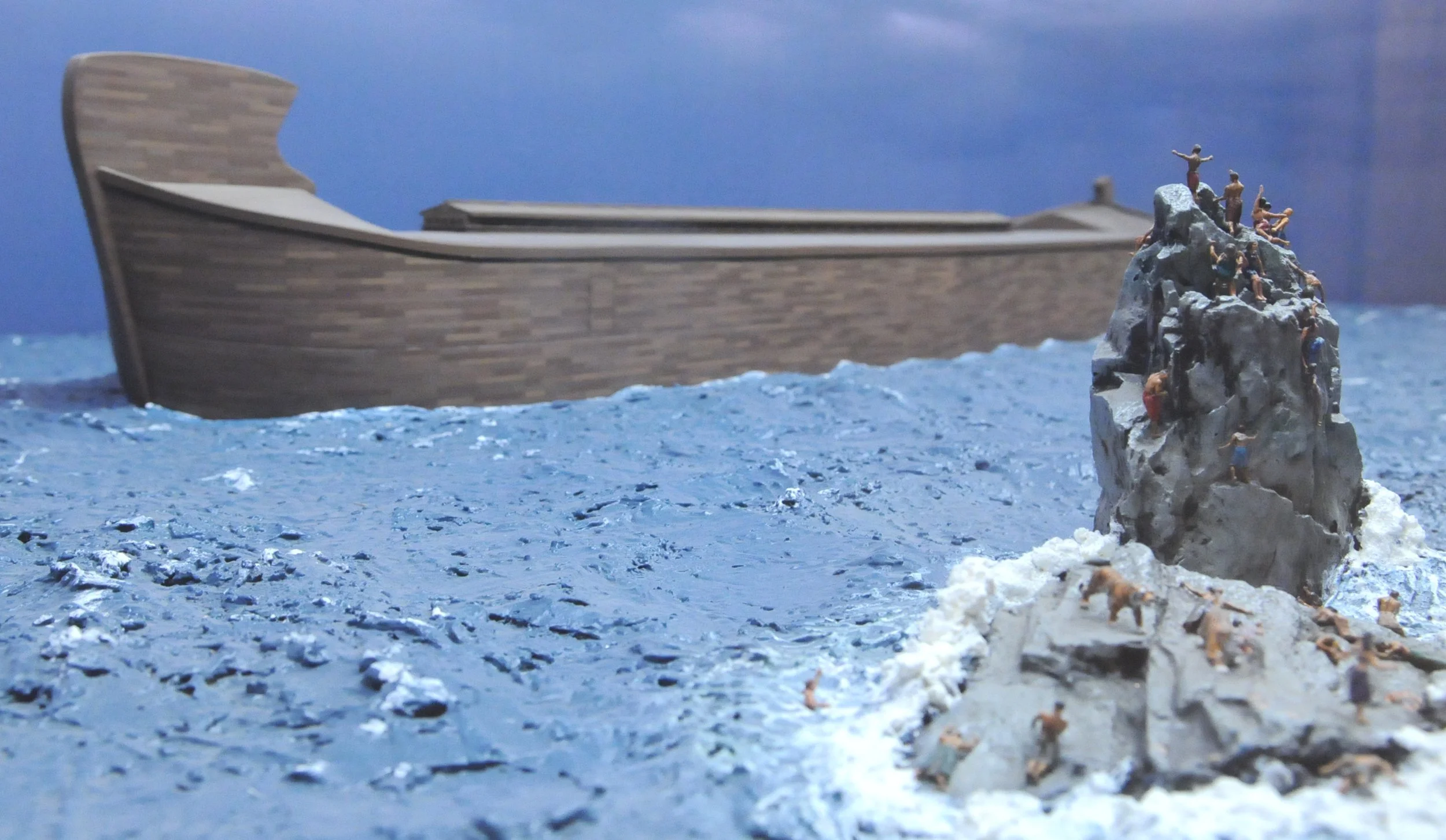
(Photo: Diorama at Answers in Genesis' Creation Museum showing Noah's Ark and people left behind on a rock. Photo by Tim Helble.)
Introduction: Hello, readers of At My Whit’s End. This is your usual writer, Shamus, here to introduce something new. A guest writer! I want to expand the scope of the project a bit and allow new voices to come in every so often to give different takes and perspectives on Adventures in Odyssey. Today I’ve invited writer and former hydrologist Tim Helble to cover the Noah’s Ark episode of AIO. Considering Tim contributed to the book The Grand Canyon, Monument to an Ancient Earth: Can Noah’s Flood Explain the Grand Canyon?, I knew he’d have a unique take on the topic. Take it away, Tim!
I heard my first episode of Focus on the Family’s Adventures in Odyssey while driving home from a church event in the late 1980’s. The voices in Adventures in Odyssey seemed a bit over-the-top – narrator Chris tried a little too hard to sound “kid cool;” the kid’s voices were a bit too perky and high pitched; and seniors like Mr. Whittaker had stereotypical, breathy old people’s voices. The kids would have some kind of question about life and Mr. Whittaker always had the evangelically-correct (EC) answers. Does that sound like anything that is going on today? I can see how many evangelicals would like to have a one-stop, EC storehouse of answers to tough questions about religion. This would keep kids from learning how to check out multiple information sources and synthesize various facts and opinions into coherent explanations for why things are the way they are – the very definition of what social psychologists refer to as integrative complexity. Perhaps I should have considered that one of Adventures in Odyssey’s goals might have been to stifle such complex thinking and shape kids’ worldview while their brains were still operating in a good vs. evil, all-or-nothing thinking mode.
The topic of how evangelicals became so influential is really interesting to me, because I lived through the time when it all started. It was evangelicals who figured out early on that radio and television were ideal ways to disseminate their message. In the 50’s and 60’s, faith-based programming was more-or-less integrated into the secular media. For example, in Los Angeles, you could hear the Sunday broadcast of Music & the Spoken Word with the Mormon Tabernacle Choir on AM radio KFI, which my dad always played as we drove to church. In the 1960’s, I remember my dad speaking derisively about Dr. Schuller’s drive-in church in Anaheim. You could watch Dr. Schuller’s Hour of Power church service on a local TV station. I also recall seeing faith healer Kathryn Kuhlman on daytime TV and wondering why her eyes were always shut.
Christian radio and TV programming seemed to take an increasingly evangelical bent in the 1970’s. Early in that decade, I sometimes watched notorious cult leaders Tony and Susan Alamo on late night TV. I also remember watching a lot of Billy Graham crusades. I started listening to John MacArthur’s Grace to You on the radio in the late 1970’s. The Jesus Movement was in full swing. In southern California, you couldn’t go to popular places like the beach without running into a Jesus freak greeting you with “hi, did you know Jesus loves you?” At the same time, many baby boomers started to feel that mainline denominations like the Presbyterians and Methodists had gone too liberal. All this led many conservative baby boomers and recent Jesus Movement converts to congregate in huge megachurches like Calvary Chapel.
The grouping of “true believers” into megachurches of 10 to 20 thousand or more made them easy targets for the Standard Christian Apologetics Machine (SCAM), which was firing on all cylinders by the 1980’s. Apologetics can be thought of as any effort to help members of a group respond to questions or criticism from the outside and assure members they hold to the correct set of beliefs and practices. For evangelicals, the guiding principle for apologetics comes from 1 Peter 3:15 -- "Always be prepared to give an answer to everyone who asks you to give the reason for the hope that you have. But do this with gentleness and respect" (New International Version Bible).
SCAM consists of hundreds of parachurch ministries – i.e., organizations that aren’t accountable to normal church leadership structures. With SCAM, the Bible (or more accurately, God’s self-appointed leaders in each ministry) has almost all the answers – very little uncertainty, mystery, or “we don’t really know.” See this Tia Levings video for an example of how apologetics works in an evangelical/fundamentalist family. SCAM has many cogs, including apologetics writer/speakers like Josh McDowell, Ravi Zacharias, and Charlie Kirk; counter-cult/apologetics ministries like the Christian Research Institute; apologetics books like Gleason Archer’s Encyclopedia of Bible Difficulties and Norman Geisler and Thomas Howe’s When Critics Ask; Christian nationalist historians like David Barton; and what I consider to be the most problematic and dangerous, the young earth creationist ministries like the Institute for Creation Research and Answers in Genesis. More on that last group later.
Many other entities could be regarded as having apologetics goals, such as family ministries like James Dobson’s Focus on the Family, Bill Gothard’s Institute in Basic Life Principles, and Gary and Anne Marie Ezzo’s infamous Growing Kids God’s Way; home school curriculum companies like Abeka and Apologia; Christian fiction books like Tim LaHaye’s Left Behind series and Frank Peretti’s This Present Darkness; and end times prophets like Hal Lindsey, John Hagee, and Harold Camping. These can be regarded as apologetics because their goal is to provide answers and alternatives to “secular” influences, shape worldviews, and identify out groups.
One thing that really fascinates me about the 1960’s to 1990’s time frame is that the mainline denominations really didn’t have an organized response to SCAM and evangelical influences in general. They just sort of let them seep into the churches. They didn’t help my friends and I learn how to dialog with the Jesus freaks. They didn’t help people learn how to identify the bad theology of some SCAM ministries. They didn’t help provide members with reasons why they should stay instead of joining the megachurches and help them see the risks associated with non-denominational megachurches led by pastors that didn’t have any real accountability to a church governing structure. They held to outdated dress codes that turned off young people and stuck with a rigid liturgical worship structure that appealed more to older generations. But at the same time, they didn’t help people see the problems with contemporary Christian music that too often focused on self and “getting saved.” They allowed SCAM materials like young earth creationist books and cassette episodes of Adventures in Odyssey into church libraries. They didn’t do near enough to counter young earth creationism, which really took off in the 1960’s and 70’s with John Whitcomb and Henry Morris’ book The Genesis Flood.
Perhaps mainline pastors didn’t confront SCAM out of fear of ticking off the few remaining conservatives in their congregations. Perhaps they were preoccupied with social justice issues, such as U.S. involvement in Central America, nuclear disarmament, and the battle over the ordination of gays and lesbians. It could be that mainline pastors and their congregations were too focused on peacemaking, coexistence, and Christian unity to notice the dangers posed by SCAM. It is also possible that pastors were just too fixated on the lectionary schedule to notice how SCAM was impacting their congregations. Or maybe they were just overwhelmed by the sheer number of SCAM/parachurch ministries which controlled the airwaves. Most pastors had little or no background in science, so they didn’t have much ammunition to counter the pseudoscience of the young earth ministries.
SCAM, Adventures in Odyssey, and Noah’s Flood
We can see aspects of SCAM in Episode #56 in the Adventures in Odyssey series: By Faith, Noah… In this episode, young Jack and Lucy have questions about faith and being a Christian. The episode starts off with a brief dramatic reenactment of a young boy named Billy trapped in his 2nd floor bedroom by a fire. His father implores Billy to jump from the window into his arms, but Billy is afraid. But there is something about this drama that grates on you. Billy has two choices – 1) get his rear end incinerated by the fire, or 2) jump down into his father’s arms. We’re sort of left hanging – Billy fears that it’s too high and his father might drop him, so he seems to prefer option 1.
Mr. Whittaker starts to discuss this with Jack and Lucy. He describes option 2 as an act of faith, but faith in a religious context involves things unseen. In the real world, jumping into your father’s arms would really be an act of trust. Mr. Whittaker states that “the real meaning of faith is trust” as if they are interchangeable. I like what Jack says in response: “it’s different in real life. I mean, it’s hard to really have faith in somebody you can’t see.” The thing that bugs me about this dialog is the way it downplays the fact that Christian faith involves mystery, things unseen, and acceptance of uncertainty. One of the main problems with SCAM is that there are questions that we’ll never get the answers to in this life.
Mr. Whittaker then invites Jack and Lucy upstairs to the “Bible room” to learn more about faith. The “Bible room” is a cutesy dramatic device which feeds off the evangelical narrative that the Bible has the answers to everything. That alone has some theological issues which could take whole separate blog post (like this) to deal with, or maybe even a book (like this). Anyway, in the Bible room, Mr. Whittaker starts talking about how Noah demonstrated great faith by obeying God and following Him. The Bible room has magical power and we’re quickly transported back in time to when the real Noah could be seen and heard. In the ensuing humorous dialog, we hear Noah telling his wife how God is going “to destroy all of mankind and all the animals” and has instructed him to build an ark to hold a year’s worth of food for his family and two of every living thing, male and female. Of course, she is a submissive, EC wife who knows her place and there is no collaborative decision making on this. The story then devolves into a silly story where Noah demonstrates his great faith by persisting in his mission despite all sorts of bureaucratic obstacles and ridicule. Noah is accused of:
1. Building without a permit.
2. Hiring non-union workers.
3. Not providing equal opportunity in hiring workers
4. Imposing his morality on other people.
5. Keeping animals in a confined area.
6. Double-parking the Ark.
What? Why was it necessary to include these in the story to explain Noah’s faith, when none of them are even mentioned in the Bible? Could Focus on the Family be slipping in a little political indoctrination, the rhetorical equivalent of sticking your dog’s medication in a teaspoon of peanut butter? I can see how the pro-business, right wing script writers at Focus on the Family might not be able to pass up an opportunity to take a jab at unions – I mean, “everyone” knows union workers goof around on the job, do sub-par work, get paid a lot more than non-union workers, and (horrors) tend to vote Democrat (or at least, they used to), right? And equal opportunity – we all know how conservatives feel about that. But the one about Noah imposing his morality on everyone else really stands out. Could this be more like the Adventures in Odyssey writers trying to condition kids to see (perceived) liberals as immoral people who are trying to obstruct God’s plan?
Focus on the Family’s The Truth Project and Noah’s Flood
Bad as these problems are, the main one is not so much with episode 56 of Adventures in Odyssey, but rather what Focus on the Family teaches about Noah’s Flood and science in general in other places. The problem can be traced back to at least 2006, when Focus on the Family published a twelve DVD set called The Truth Project. According to the Focus on the Family website, “The Truth Project is a ground-breaking small group curriculum on the Biblical worldview.” The Truth Project was developed by former senior vice president of Focus on the Family, Del Tackett, an all-around, nice sounding guy who never seems to miss an opportunity to advance another false dichotomy. From what I can gather, Tackett has no degree in a scientific or theological discipline, but that doesn’t stop him from sounding like an expert in both areas.
The twelve DVDs comprising The Truth Project cover a host of topics, but the one I want to zero in on is Disc 5: “Science: What is True?” In this DVD, Tackett puts his anti-science views on display by characterizing natural science as being opposed to God. His entire discussion is built around the idea that unbelievers don‘t see God’s plain revelation in nature because they “suppress the truth” in unrighteous living (Romans 1:18). He’s basically indoctrinating his viewers to see everything in terms of conflict – not so subtly suggesting that the reason people accept sciences like geology, astronomy, and evolution is they have some kind of hidden or not-so-hidden sin. Tackett never entertains the possibility that science could just be describing how God did it and the creation account in Genesis wasn’t intended to be taken in a wooden literal sense. He also ignores that possibility that many Christians who accept science are walking as closely, or more closely, with God than many darlings of modern evangelicalism.
I wasn’t the first person to see The Truth Project as indoctrination. Theologian Randal Rauser felt the same way, stating: “The Truth Project fails to provide a true Christian worldview education, and instead evinces the marks of indoctrination.” I personally attended a discussion on The Truth Project shortly after the DVDs came out, and I’ve watched a few videos of other church groups discussing it. It seems pretty clear to me that Tackett’s target audience is not operating at the highest levels of thinking complexity. His target audience is pre-disposed to absorbing indoctrination that comes under the banner of “Christian.” They are especially susceptible to false dichotomies – e.g., “if the earth is old, then there is no God.” They are mainly looking for apologetics to reaffirm already-existing beliefs, not new information that challenges their traditional, evangelically-correct views. At the discussion I attended, there might have been a few who weren’t so inclined, but they seemed to me to be in the minority.
Disc 5 (Science: What is True?) focuses mostly on the evils and perceived problems of Darwinian evolution, but Tackett manages to slip in his views on Noah’s Flood near the end. Tackett says that Noah’s Flood was a literal, historical, global event initiated by God as righteous judgment against human wickedness. Tackett doesn’t come out and say it in The Truth Project, but he believes the global Flood was responsible for completely rearranging the planetary geologic record. Not just at the surface where most people think about flood impacts – all the way deep underground. Like, all the layers you see in the walls of the Grand Canyon and just about anywhere else were laid down by Noah’s Flood in less than a year. And if you don’t believe Noah’s Flood did all that, you’re probably one of the people who are “suppressing the truth” in unrighteous living. I’m going off on a tangent here, but this key cog of SCAM known as flood geology is serious stuff. We need to understand that it’s the rhetorical equivalent of a highly contagious brain worm that is ruining the scientific literacy of a huge segment of the U.S. population.
Tackett and Is Genesis History?
After The Truth Project, Tackett decided to cast his lot with flood geology and in 2017, narrated a documentary movie produced by Thomas Purifoy entitled Is Genesis History? The movie premiered a special one-day event theater screening. After that, Is Genesis History? came out on DVD and streaming and is now available for free on Youtube. At that time, I was heavily involved in writing the book The Grand Canyon: Monument to An Ancient Earth – Can Noah’s Flood Explain the Grand Canyon?, which exposes many errors of flood geology. Since I had seen online previews mentioning the Grand Canyon, I paid $12 to see Is Genesis History? in a theater. I took four pages of notes during the movie, noting various problems with Tackett’s arguments along the way. Is Genesis History? has problems from the very start, where Tackett stands in front of Mt. St. Helens and makes it clear that he is 100% sold on flood geology. See here and here, and here for some examples of the problems with Is Genesis History? The entire movie basically consists of interviews with flood geologists (yes, there are more than one!). Keeping with Tackett’s style, the movie is filled with false dichotomies. In fact, one of the people he interviewed in the movie, Paul Nelson, issued a dissent to the way he was portrayed, stating: “I have consistently explained that, given one’s assumptions, an array of differing positions — more than two, certainly — exist concerning origins.”
Flood Geology and Science Denial
So what’s the matter with flood geology? As I already stated, flood geology posits that Noah’s Flood covered the entire earth and completely reworked the planetary geologic record. This turns out to be geologically and quantitatively absurd in many ways. To this date, not one flood geologist has identified a single geologic formation that shows evidence of being laid down at the astronomical deposition rates required by the global Flood. They’ll try to give you lots of evidence for underwater deposition, but nothing that supports the fantastical deposition rates required by flood geology. Obviously, it took a pretty sophisticated propaganda effort to fool millions of people into believing this stuff. How did SCAM geologists pull this off?
For one thing, SCAM presents flood geology as a necessary part of “biblical authority.” See, if you add up all the ages of people in the early chapters of Genesis, you get an age of the earth of about 6,000 years (maybe 10,000 years if you’ll admit there are a few time gaps). SCAM had to figure out a way to explain all the fossils found in miles of sedimentary strata throughout the world. Dinosaur fossils were an especially thorny problem, because kids love dinosaurs. When did they exist? Their solution was easy – they just said that dinosaurs and humans existed together before Noah’s Flood and the Flood buried everything on the planet except for the animals Noah brought on the ark and whatever was able to survive by swimming or flying around during the Flood. Then, they hope nobody will notice that they’re committing the assumed conclusion fallacy in saying that “billions of dead things” buried throughout the geologic strata are proof of Noah’s Flood. But you should see how they explain how dinosaur footprints were made during the middle of the Flood!
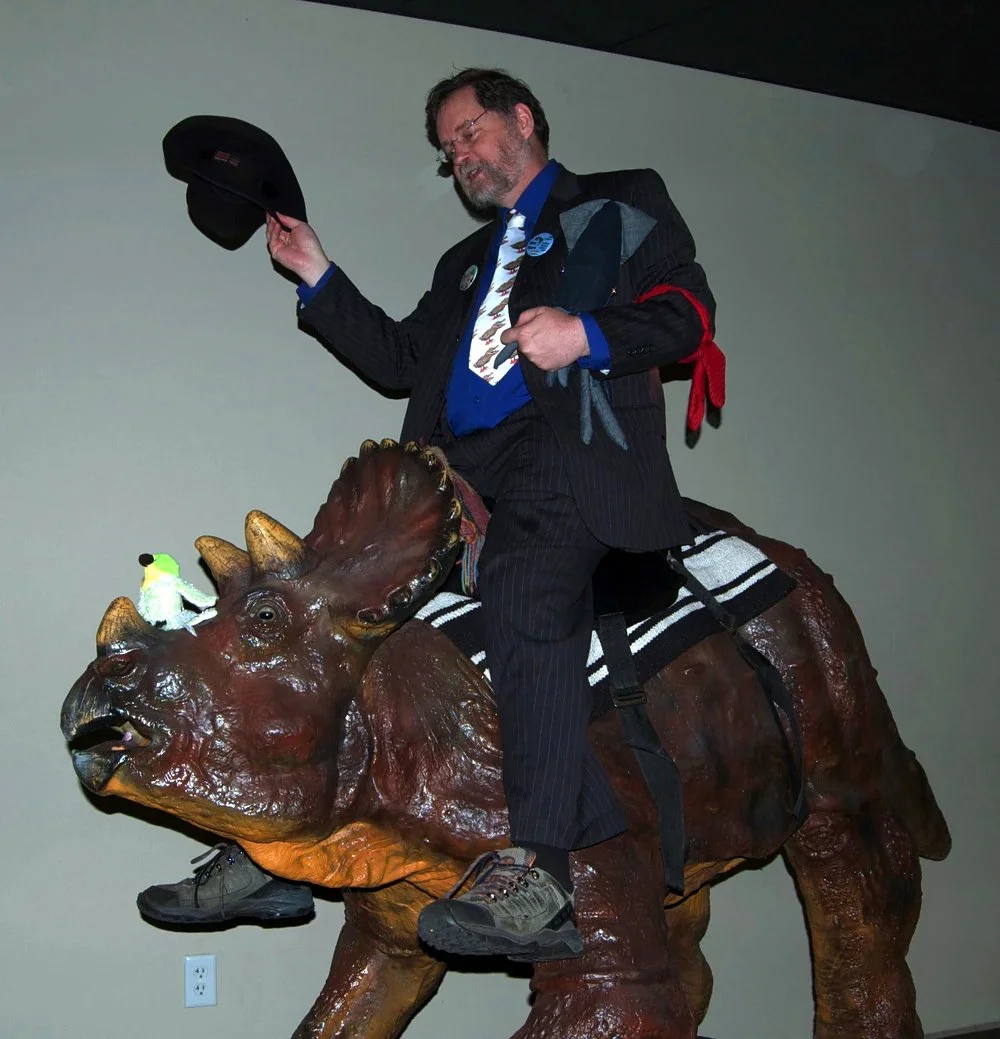
(Photo: Biology professor and avid critic of young earth creationism PZ Myers riding a dinosaur sculpture at the Answers in Genesis Creation Museum. A sign was later added to the pedestal stating "children only" after critics such as Myers starting posting photos of themselves riding the dinosaur. Photo by Sminhinnick, Creative Commons Attribution-Share Alike License 3.0 (Unported) (CC BY-SA))
I find that almost all rank-and-file young earth believers are unaware of the magnitude of the planetary geologic record. When I tell them that the Colorado Plateau has over three miles of sedimentary layers (average) that were supposedly laid down by Noah’s Flood, they can’t believe that the layers are really that deep. They picture the Flood as being like tides on a seashore laying down widespread layers of sand that really aren’t that thick. Well, maybe they would say it was a little more catastrophic than that (they often mention tsunamis), but the way they visualize how the Flood laid down rock layers usually turns out to be tame compared to what would actually be required. The young earth leaders like Ken Ham always depict Flood waters with a nice blue color, but the water would really have to be creamy brown. I mean astronomically off-the-scale loaded with sediment. Yet despite the required astronomical sediment deposition, Tackett, Ham, and their supporting cast of flood geologists teach that finely detailed features like fossil footprints and thin, one millimeter-thick layers in shale are actually the product of a global Flood. Tackett even narrated a second movie entitled Is Genesis History? Mountains After the Flood, which prominently features a flood geologist who devoted most of his adult life trying to convince people that a prominent layer in the Grand Canyon that was formed by desert sand dunes was actually deposited by Noah’s Flood.
As I already pointed out, rank-and-file young earth believers don’t tend to be the most integratively complex people you’ll ever meet. They do make good literalists – i.e., people who believe that the English words in their preferred Bible translation should be interpreted in a wooden literal sense. I’ve also noticed that young earthers tend to be two-dimensional thinkers who aren’t very good with conceptualizing volumes or rates. They may have been flood geology believers for many years, but have no idea that the volume of fossils in the geologic record is far too great to have existed at the same time before the Flood. Given the enormous volume of fossil sea life (e.g., crinoid stems) found in rocks supposedly laid down by the Flood, they don’t realize that the land surface that Noah lived on before the Flood would have been covered with crunchy shells and other sea life remains that went down hundreds if not thousands of feet.
This raises an interesting question regarding what educators could do to reduce the number of future flood geology believers. One thing might be to just impress on students the enormous thickness and complexity of earth’s sedimentary layers. Just keeping kids amused by taking them to a museum to look at dinosaur fossils isn’t enough.
The Impacts of Science Denial on All of Us
So evangelical Christians are taught that science actually supports a global Flood, and tens of thousands of geologists are in a conspiracy to cover this up. This is ridiculously wrong, but what makes this really harmful is that they basically extend this conspiracy to all scientists – climate scientists, astronomers, cosmologists, environmental scientists, biologists, paleontologists, vaccine scientists – you name it and the scientific discipline probably makes the evangelical enemies list. Many evangelical leaders take it further, teaching that there is no real reason to be concerned about climate change, overconsumption, and the environment because the present world is going to end soon with Jesus’ return. Pastor John MacArthur described this attitude perfectly in stating:
“…The earth we inhabit is not a permanent planet. It is, frankly, a disposable planet – it is going to have a very short life. It's been around six thousand years or so – that's all – and it may last a few thousand more. And then the Lord is going to destroy it.
I've told environmentalists that if they think humanity is wrecking the planet, wait until they see what Jesus does to it. Peter says God is going to literally turn it in on itself in an atomic implosion so that the whole universe goes out of existence (2 Peter 3: 7-13).
This earth was never ever intended to be a permanent planet – it is not eternal. We do not have to worry about it being around tens of thousands, or millions, of years from now because God is going to create a new heaven and a new earth. Understanding those things is important to holding in balance our freedom to use, and responsibility to maintain, the earth…”
Thankfully, some evangelicals are beginning to accept the scientific consensus of climate scientists, such as the Young Evangelicals for Climate Action. However, Focus on the Family clearly feels that there are more important things, stating:
Despite the uncertainty, some evangelical leaders have insisted global warming should be prioritized as the most important social issue that confronts us today. Focus on the Family firmly disagrees. For some evangelicals to position the theory of human-induced global warming above the reality of the ongoing attacks against the family and a Christian worldview is perplexing and troubling. (Focus on the Family Position Statement – A Response to the Global-Warming Debate)
For some evangelicals, the problem is even worse. The former pastor of a church I attended told me that climate scientists are being used by a shadowy entity that wants to implement a one-world government. He also thinks HAARP (High-frequency Active Auroral Research Program) is being used to modify the weather, so that should tell you something. Focus on the Family and people like Del Tackett do nothing to change such attitudes, and imply that the only scientists you can trust are the ones who support “a biblical worldview.” Like the flood geologists Tackett interviews on Is Genesis History? The problem is, we’re living in a time when we need to be listening to what real scientists have to say more than ever. We can only hope that Focus on the Family and Tackett’s influence will decrease, at least where it comes to science.
A Few Closing Thoughts
Towards the end of the Adventures in Odyssey episode, Mr. Whittaker, young Jack, and quotes from scripture are used to repeat the idea that Noah’s Flood destroyed all the earth. But they never explicitly come out and say that the Flood completely reworked the planetary geologic record. It could be that Focus on the Family was just prepping kids for future acceptance of flood geology, leaving it to people like Del Tackett to fill in the details. The problem with this is that they never consider that “all the world” could just mean all the world known to Noah – that is, the Mesopotamian Valley. The bible says all the world came to Egypt to buy grain from Joseph. Does that mean that the Mayans and the Inuits paddled across the Atlantic Ocean to buy grain from Joseph?
In closing out episode 56, narrator Chris says that “through faith, we can be close to God, have our prayers answered, and have victory in all areas of our lives.“ That strikes me as a rather self-focused description of the outcome of faith. Couple that with belief that SCAM has all the answers to questions about Noah’s Flood and just about everything else and you might well be on the way to becoming a fact-resistant evangelical conservative. It seems that Focus on the Family and Del Tackett are more comfortable with an inward focused, “me first, my rights first” kind of person than one who sees the importance of listening to what scientists are saying about critical issues that face all of us like overconsumption and global warming.
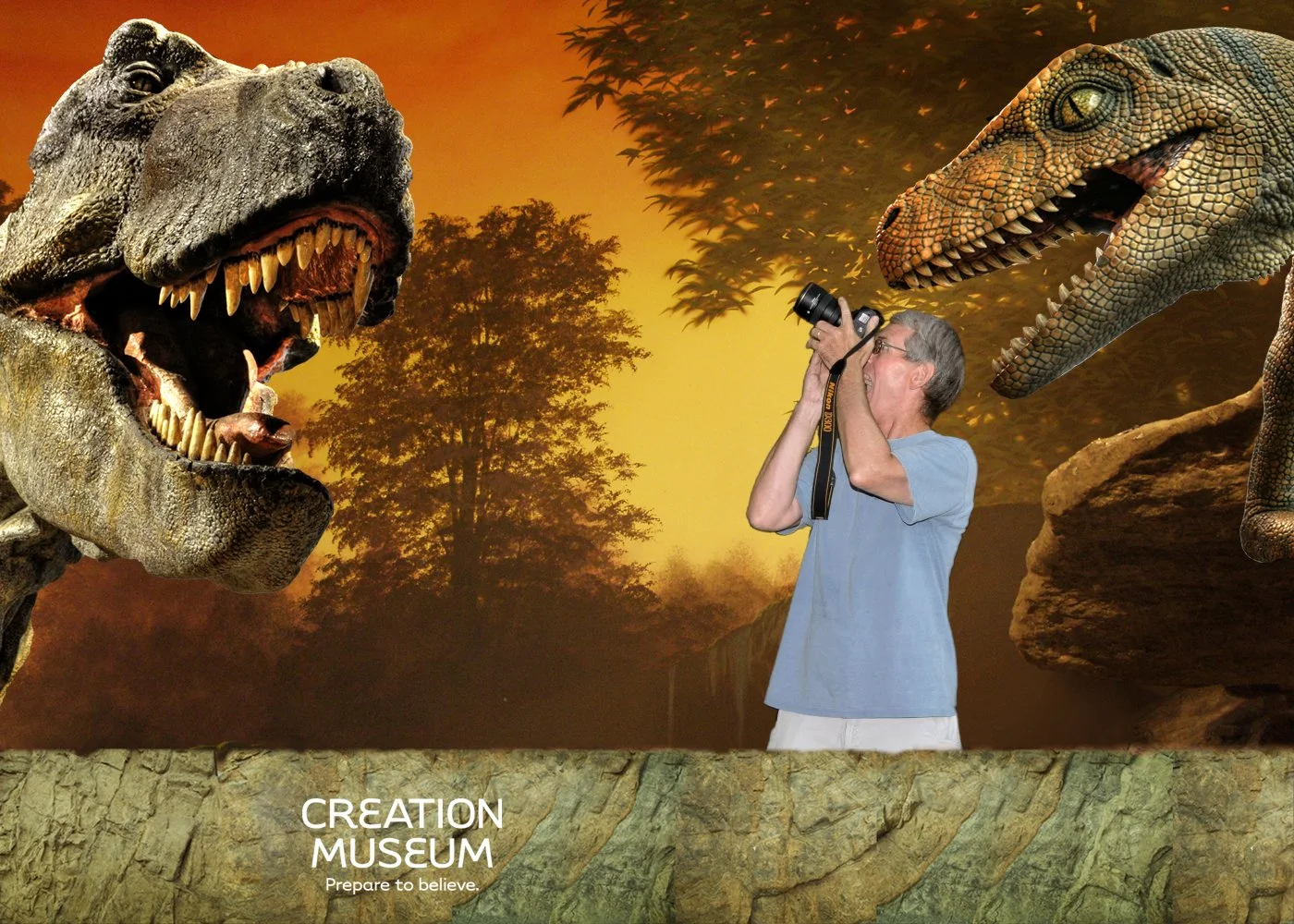
(Photo: Tim Helble in front of the green screen at the Answers in Genesis Creation Museum.)
Bio: Tim Helble has been involved in science communication and the effort to counter young earth creationism since retiring from his hydrologist position in the National Weather Service. He has been interested in the creation-evolution controversy since about age 10, back when Lyndon Johnson was president (do the math). The catalyst for Tim’s interest in that subject was probably a ranger talk about glaciers at Yosemite National Park. He began his hydrologist career many years later with a six-month stint at Grand Canyon National Park. He was an author and editor of the book The Grand Canyon, Monument to an Ancient Earth: Can Noah’s Flood Explain the Grand Canyon? (2016), which exposes many errors of an evangelical apologetics effort known as flood geology. Tim could probably be regarded as an “exvangelical,” but still considers himself to be a Christ follower, if that makes any sense to the readers here. He was never a big Adventures in Odyssey fan like Shamus, but he’s listened to quite a few episodes over the years.